There is a particular pleasure in discovering that a world-class natural area is hiding in plain sight, just off the interstate and barely twenty minutes from downtown Minneapolis. Elm Creek Park Reserve, part of the Three Rivers Park District, is that kind of place — sprawling, diverse, and quietly extraordinary in ways that reward both the casual visitor and the dedicated outdoor enthusiast.
Located in the northwest Twin Cities suburbs, the park spans portions of Maple Grove, Champlin, and Dayton — three communities that most people drive through on I-94 without giving much thought. But pull off the highway and head into Elm Creek’s nearly 4,900 acres, and the suburbs disappear fast. What you find instead is floodplain forest, restored prairie, wetlands alive with nesting birds, miles of trail, and a park that genuinely earns the word “reserve.”
Whether you’re a hiker, a cyclist, a cross-country skier, a birder, a family with young kids, or a dog owner looking for room to roam, Elm Creek has something waiting for you in every season.
The History of Elm Creek Park Reserve
A Race Against Suburbanization
The story of Elm Creek Park Reserve begins not at the park itself, but with a big idea that took more than half a century to become reality. As early as 1901, civic leaders in Hennepin County were discussing the need for a large-scale regional park system — not the neighborhood playgrounds and small city parks that most communities were building, but something much larger and more ambitious.
It took until 1955 for the Minnesota Legislature to pass the enabling legislation, and the Hennepin County Park Reserve District was formally established in 1957. The founding mission was clear from the start: acquire large natural areas — forests, wetlands, prairies, wildlife habitat — before postwar suburban growth consumed them. The timing proved critical. In its first decade, the Park District moved quickly, purchasing nearly 21,000 acres of mostly farmland across Hennepin County’s expanding suburban fringe. The land was relatively affordable, and the District’s founders knew that window would not stay open long.
They were right. The farmsteads and fields that became Elm Creek Park Reserve would, without that foresight, almost certainly have become another network of subdivisions and strip malls. The Park District essentially raced sprawl and won — at least in this corner of the county.
The District went through several name changes along the way — unofficially known for years as “Hennepin Parks,” then renamed the Suburban Hennepin Regional Park District in 1985, and finally Three Rivers Park District in 2005. That last name reflects the geography of the system: the parks sit within watersheds draining into three rivers significant to this region — the Mississippi, the Minnesota, and the Crow.
The Land Before the Park
The Elm Creek land itself carries a human history that long predates the park. Among the most intriguing chapters is the settlement of Swiss immigrant families in the 1800s, who farmed the rich soils along the creek corridors here. Artifacts and stories from those early pioneer families are preserved and displayed inside the Eastman Nature Center today, grounding the park’s natural story in the human one that preceded it.
Geologically, the landscape visitors walk through at Elm Creek is classic Minnesota glacial terrain — shaped by the retreat of massive ice sheets at the end of the last Ice Age, roughly ten thousand years ago. The rolling hills, the wetlands, the creek valleys carving through hardwood forest — all of it is a direct inheritance from glacial activity. Elm Creek and Rush Creek, which flows through the park’s eastern section, are products of that legacy, draining through a landscape of moraines and outwash plains left behind when the ice pulled northward.
Whitney Eastman and the Nature Center That Bears His Name
No history of Elm Creek would be complete without the story of Whitney H. Eastman — the man whose name graces the park’s nature center and whose energy helped make it possible. Born in 1888, Eastman eventually rose to become a vice president at Archer Daniels Midland and later joined General Mills, moving to Minneapolis where he would spend his most consequential years. Along the way, he became one of the most accomplished amateur birdwatchers in the country. By 1957, his life list of confirmed bird species stood at 1,327 — a staggering number that reflected decades of meticulous observation and far-flung travel.
But Eastman’s legacy at Elm Creek is as much about civic energy as personal passion. In 1967, when Goodrich Lowry organized the Metropolitan Nature Centers Corporation to fund the construction of nature centers within the new park reserves, Eastman stepped up to chair the fundraising committee. The goal for the first center, at Carver Park Reserve, was half a million dollars. Eastman’s committee raised it in six months. With leftover funds, the Corporation asked the Park District whether a second center could be built — and Elm Creek was chosen.
On Eastman’s 85th birthday in 1973, the Park District voted to name the Elm Creek center in his honor. It was dedicated in 1974 and has served as the park’s educational and interpretive heart ever since. Today the renovated 14,000-square-foot building features floor-to-ceiling windows for indoor wildlife watching, classrooms, live-animal exhibits, a quiet reading room, an open-air deck, and a small coffee service. It remains one of the finest nature center facilities in the Twin Cities metro.
Restoration and Living Science
Elm Creek is not a static preserve — it’s an actively managed, continuously evolving natural system. Beginning in the 1980s, the Park District began planting restored prairies within the park to recover native habitat that had been lost to agricultural use. Those prairies are now managed with regular prescribed burns and serve as research sites for native plant and insect study.
More recently, a multi-phase woodland and savanna restoration project launched in 2024 is working to restore 42 acres of oak woodland in the park’s northeastern section. The project involves the removal of invasive buckthorn, herbicide treatment of re-sprouting invasive species, and seeding of native plants — all funded through Minnesota’s Clean Water, Land and Legacy Amendment and the Minnesota DNR.
Researchers from the University of Minnesota have also partnered with the Park District to monitor white-tailed deer in and around Elm Creek — tracking habitat use, movement patterns, and disease. Pollinator surveys have confirmed 15 different bumblebee species between Elm Creek and the adjacent Crow-Hassan Park Reserve, out of at least 20 species known to exist in Minnesota. This is, in every meaningful sense, a working landscape — one where recreation and ecological science coexist.
What to Do at Elm Creek Park Reserve
Hiking
Elm Creek offers two distinct hiking experiences depending on which side of the park you explore. At the Eastman Nature Center, 6.5 miles of dedicated hiking and snowshoeing trails wind through the sugar maple and basswood floodplain forest along Rush Creek. The beloved floating boardwalk is a highlight — a quiet, immersive crossing over the creek that puts you right in the middle of the riparian habitat. Named trails here include the Sumac Trail, the Heron Trail, and the Monarch Trail, all of which are excellent for fall color viewing in late September and October. Interpretive signs, cellphone audio stops, and trail guide sheets are available to enrich the experience.
On the Recreation Area side, the paved multi-use trail system loops through a wider variety of habitats — past the swimming pond, through restored prairie sections, and into the deeper and wilder portions of the reserve. These trails connect to the broader regional trail network, giving ambitious hikers and walkers access to a much larger corridor.
Biking
Elm Creek has more bike trail miles than any other park in the Three Rivers system — a distinction worth noting. The paved multi-use network covers 19 miles, while the singletrack mountain bike trail system adds another 13 miles of winding, forested trail designed for a more technical riding experience. The regional connections are equally impressive: the Rush Creek Regional Trail links Elm Creek to Mississippi Gateway Regional Park, and the Crystal Lake Regional Trail extends southward, eventually connecting to the Minneapolis Grand Rounds. Experienced cyclists can string together a substantial route without ever riding on a roadway.
Horseback Riding
With 21 miles of designated horse trails, Elm Creek offers one of the most extensive equestrian trail systems in the Twin Cities metropolitan area. The trails traverse a variety of terrain and are maintained separately from the paved and hiking networks.
Swimming
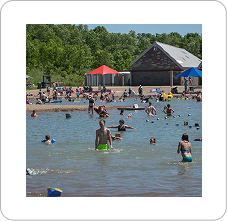
The swim pond is one of the park’s most beloved summer amenities — a chlorinated, filtered body of water with a sand beach, lifeguard station, concessions, and bathroom and changing facilities. It attracts families from across the metro on hot summer days, so arriving early or planning a weekday visit is a practical strategy. A daily or annual pass is required.
Disc Golf
The championship-level disc golf course at Elm Creek has earned a devoted following among Twin Cities disc golfers. Set across varied terrain that rewards both power players and precision throwers, it’s the kind of course that earns a regular spot in players’ rotation rather than just an occasional casual round.
Winter Activities
Winter transforms Elm Creek into one of the metro’s premier cold-weather outdoor destinations. The cross-country ski trail system spans 11 miles, with portions served by snowmaking — a feature that makes skiing possible even in lean-snow winters, which Minnesota increasingly experiences. Trails are groomed and tracked for both classic and skate skiing.
The snowtubing hill at the Winter Recreation Area features 12 laned runs, 10 stories high, served by a carpet lift. Advance reservations are required and sessions fill quickly, especially on weekends — booking ahead is strongly recommended. A small downhill ski and snowboard area with a terrain park rounds out the alpine offerings, providing a convenient local option for those who don’t want to make the long drive north.
Snowshoeing at Eastman covers 6.5 miles of dedicated trails with interpretive signage and exploration tools available from the nature center. And for those who haven’t tried skijoring — cross-country skiing while being pulled by a dog — Elm Creek has more than seven miles of packed multi-use trails designated for exactly that activity. A sledding hill with minimal grooming is also available in the Recreation Area.
Wildlife Watching and Birding
Elm Creek’s wildlife list reads like a highlights reel of Minnesota’s natural heritage: eagles, sandhill cranes, trumpeter swans, loons, great blue herons, bluebirds, wild turkeys, dragonflies, beavers, and deer. The Eastman Nature Center side of the park, with its floodplain forest and Rush Creek corridor, is particularly productive for birding. The building’s floor-to-ceiling windows serve as an excellent indoor observation point, and the adjacent pond has a dedicated observation blind for those who want to be patient and quiet about it.
Birdwatching checklists are available at the nature center, and staff-led birding programs run seasonally. The park has even hosted bird banding sessions open to the public — the kind of hands-on experience that tends to make a lasting impression.
Hidden Gems
A few things at Elm Creek that don’t always make the main attractions list but are well worth seeking out: the 30-acre archery range on the park’s northwest side is among the largest in the region. The restored prairies, particularly in late summer when native wildflowers are at peak bloom, are genuinely beautiful and often overlooked by visitors who stick to the paved paths. Vernal pools in spring attract a surprising diversity of amphibians and invertebrates — the nature center offers programming timed specifically to this seasonal phenomenon. And the park’s pollinator-rich meadows in summer buzz with activity that rewards anyone who slows down enough to notice.
Camping and Overnight Options
Elm Creek has two camper cabins available for overnight stays, situated in a semi-remote area of the park. Each cabin measures 12 by 16 feet; one is accessible for guests with disabilities and sleeps five, and the other sleeps six. These are rustic accommodations — no flush toilets or shower facilities — but they offer a genuine immersion in the park at a level that day visits simply can’t replicate. Reservations are available up to 120 days in advance and should be made well ahead for summer weekends.
Places to Stay Near Elm Creek Park Reserve
The Arbor Lakes area of Maple Grove, just minutes from the park’s main entrances, has developed into a well-equipped hotel hub with options at a range of price points.
The Hilton Garden Inn Minneapolis Maple Grove offers comfortable rooms, free parking, and easy access to both the park and the Shoppes at Arbor Lakes. The Hampton Inn Minneapolis Northwest Maple Grove is a well-regarded option with free breakfast included — a practical perk before a long day on the trails. The Cambria Hotel and Suites Minneapolis Maple Grove steps up the experience with a spa on-site and a restaurant, making it a good choice for travelers who want to unwind after a physically demanding day outdoors. The Staybridge Suites Minneapolis Maple Grove is a smart choice for longer stays, with full kitchens in each suite and a hot breakfast included. The Holiday Inn and Suites Maple Grove is home to the Venetian Indoor Waterpark — 25,000 square feet of water fun — which makes it particularly popular with families visiting the park. And in Rogers, slightly further north, the Holiday Inn Express provides another solid, family-friendly option near both the park and the Mississippi River corridor.
Notable Things to See in the Area
The Shoppes at Arbor Lakes in Maple Grove is a lifestyle shopping and dining district with a pleasant outdoor format — a good spot for an evening out after a day in the park, with a variety of restaurants, specialty shops, and national brands.
Omni Brewing Company in Maple Grove is a well-regarded local craft brewery with a laid-back atmosphere and a rotating tap list — a fine place to debrief after a long hike or a morning ski.
Mississippi Gateway Regional Park, accessible from Elm Creek via the Rush Creek Regional Trail, sits at the historic Coon Rapids Dam on the Mississippi River. A pedestrian and bike path crosses the dam itself, and the park is part of the Mississippi National River and Recreation Area passport program — a worthwhile detour for those interested in the Mississippi corridor.
The Lyric Arts Main Street Stage in Anoka, a short drive northeast, is a well-established community theater venue that locals take seriously and out-of-towners often find as a pleasant surprise.
The Ellingson Car Museum in Rogers is a privately operated collection of meticulously restored classic and antique automobiles that consistently earns strong reviews from automotive enthusiasts and curious visitors alike.
Crow-Hassan Park Reserve in Rogers, part of the Three Rivers system and connected to Elm Creek by regional trails, offers 600 acres of restored tallgrass prairie along with hiking and equestrian trails — a complement to Elm Creek’s more forested character, and worth pairing with a visit if time allows.